



Adrenergic Receptor
Beta Receptor
Adrenergic receptors are a class of G protein-coupled receptors that are targets of the catecholamines, especially norepinephrine and epinephrine. Many cells possess these receptors, and the binding of a catecholamine to the receptor will generally stimulate the sympathetic nervous system. The sympathetic nervous system is responsible for the fight-or-flight response, which includes widening the pupils of the eye, mobilizing energy, and diverting blood flow from non-essential organs to skeletal muscle. There are two main groups of adrenergic receptors, α and β, with several subtypes. α receptors have the subtypes α1 and α2. β receptors have the subtypes β1, β2 and β3. All three are linked to Gs proteins, which in turn are linked to adenylate cyclase. Agonist binding thus causes a rise in the intracellular concentration of the second messenger cAMP. Downstream effectors of cAMP include cAMP-dependent protein kinase (PKA), which mediates some of the intracellular events following hormone binding.
Adrenergic Receptor Isoform Specific Products
All Product Categories
-
Adrenergic Receptor Inhibitors
(267)
View all products
-
Adrenergic Receptor Agonists
(502)
View all products
-
Adrenergic Receptor Antagonists
(547)
View all products
-
Adrenergic Receptor Activators
(45)
View all products
-
Adrenergic Receptor Modulators
(21)
View all products
-
Adrenergic Receptor Degraders
(2)
View all products
-
Adrenergic Receptor Controls
(8)
View all products
-
Adrenergic Receptor Substrates
(3)
View all products
-
Adrenergic Receptor Ligands
(17)
View all products
-
Adrenergic Receptor Related Products (1630)
Related Products (1630)

-
Antibodies (4)
-
Adrenergic Receptor Isoform Comparison
-
MDL-19744A
 0 ImagesCat. No.: HY-183954CAS No.: 97233-26-6MDL-19744A is an orally active and selective α1-adrenergic receptor antagonist, with rat α1-adrenergic receptor IC50 of 8 nM. MDL-19744A increases renal blood flow, dose-related decreases mean arterial blood pressure, increases urinary sodium excretion, and mediates renal vasodilation. MDL-19744A can be used for the research of hypertension.
-
Moxonidine-d3
 0 ImagesCat. No.: HY-B0374S2Synonyms: BDF5895-d3Moxonidine-d3 (BDF5895-d3) is deuterium labeled Moxonidine (HY-B0374). Moxonidine (BDF5895) is an orally active imidazoline type 1 receptor (I1-R) agonist. Moxonidine activates imidazoline I1 receptors and α2 adrenoceptors, affecting oxidized low-density lipoprotein uptake. Moxonidine reduces atherosclerotic lesions and lowers blood pressure. Moxonidine can be used in the study of hypertension, heart failure, and atherosclerosis.
-
Amosulalol hydrochloride
 0 ImagesCat. No.: HY-106720ACAS No.: 70958-86-0Synonyms: YM 09538 hydrochlorideAmosulalol (YM 09538) hydrochloride is an orally active and dual inhibitor of α1/β1-Adrenergic Receptor. Amosulalol hydrochloride exhibits antihypertensive activity via α1-Adrenergic Receptor inhibition. Amosulalol hydrochloride decreases reflexogenic increases in heart rate and plasma renin activity (PRA) via β1-Adrenergic Receptor inhibition in spontaneously hypertensive rats (SHR).
-
Metaproterenol-d7 hemisulfate
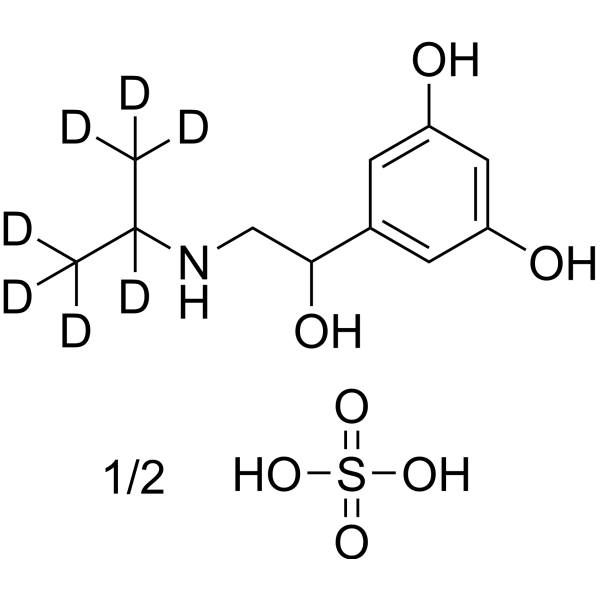 0 ImagesCat. No.: HY-B1276SMetaproterenol-d7 (hemisulfate) is the deuterium labeled Metaproterenol hemisulfate. Metaproterenol hemisulfate (Orciprenaline hemisulfate) is a direct-acting sympathomimetic and a β2-adrenergic receptor (β2AR) agonist with an IC50 of 68 nM. Metaproterenol hemisulfate also has anti-inflammatory activity.
-
Delequamine
 0 ImagesCat. No.: HY-106874CAS No.: 119905-05-4Synonyms: RS-15385-197Delequamine (RS-15385-197) is an orally active and selective α2-adrenergic receptor antagonist with a pKi of 9.5 for α2-adrenoceptors in rat cortex. Delequamine shows >1000 fold selectivity against 5-HT1A receptors and α1-adrenoceptors. Delequamine can be used for the study of erectile dysfunction.
-
Droxidopa-13C6
 0 ImagesCat. No.: HY-13458S2CAS No.: 1261397-37-8Synonyms: L-DOPS-13C6; DOPS-13C6; SM5688-13C6Droxidopa-13C6 (L-DOPS-13C6) is 13C labeled Droxidopa. Droxidopa (L-DOPS; SM5688) is a potent, orally active norepinephrine precursor. Droxidopa increases standing blood pressure, ameliorates symptoms of orthostatic hypotension and improves standing ability. Droxidopa has the potential for the research of neurogenic orthostatic hypotension (nOH) and alternative ADHD (attention deficit hyperactivity disorder).
-
Ritobegron hydrochloride
 0 ImagesCat. No.: HY-19690CAS No.: 476333-91-2Synonyms: KUC-7483 hydrochlorideRitobegron, a prodrug of the active compound, KUC-7322, is a selective β3 -adrenoceptor agonist. Ritobegron decreases intravesical pressure with minimal effects on the cardiovascular system.
-
0990CL (Standard)
 0 ImagesCat. No.: HY-102076RCAS No.: 511514-03-7
-
Luminacin G1
 0 ImagesCat. No.: HY-N14184CAS No.: 251449-96-4Luminacin G1 has a strong inhibitory effect on capillary formation (IC50 is less than 0.1 μg/mL).
-
N-Nitrosometoprolol
 0 ImagesCat. No.: HY-W726392CAS No.: 138768-62-4N-Nitrosometoprolol is an N-nitroso derivative formed by the in vitro reaction of β-adrenergic blockers with sodium nitrite. N-Nitrosometoprolol can induce micronuclei in rat liver, bone marrow and spleen.
-
Yohimbic acid ethyl ester
 0 ImagesCat. No.: HY-134125CAS No.: 73840-32-1Yohimbic acid ethyl ester (Compound 3a) is a selective ADRA2A antagonist with an IC50 of 31 nM.
-
Tuaminoheptane sulfate
 0 ImagesCat. No.: HY-W722796CAS No.: 6411-75-2Tuaminoheptane sulfate is an alpha-adrenergic receptor agonist. Tuaminoheptane sulfate exerts its decongestant and irritant effects by inhibiting norepinephrine reuptake and promoting its release. Tuaminoheptane sulfate can be used in research on nasal diseases such as decongestion.
-
Alfuzosin hydrochloride (Standard)
 0 ImagesSynonyms: SL 77499-10 (Standard)Alfuzosin (hydrochloride) (Standard) is the analytical standard of Alfuzosin (hydrochloride). This product is intended for research and analytical applications. Alfuzosin (SL 77499-10) hydrochloride is an orally active, selective and competitive α1-adrenoceptor antagonist. Alfuzosin hydrochloride relaxes the muscles of the prostate and bladder neck, aiding in urination. Alfuzosin hydrochloride can be used in study of benign prostatic hyperplasia (BPH).
-
(Rac)-Nebivolol-d4 hydrochloride
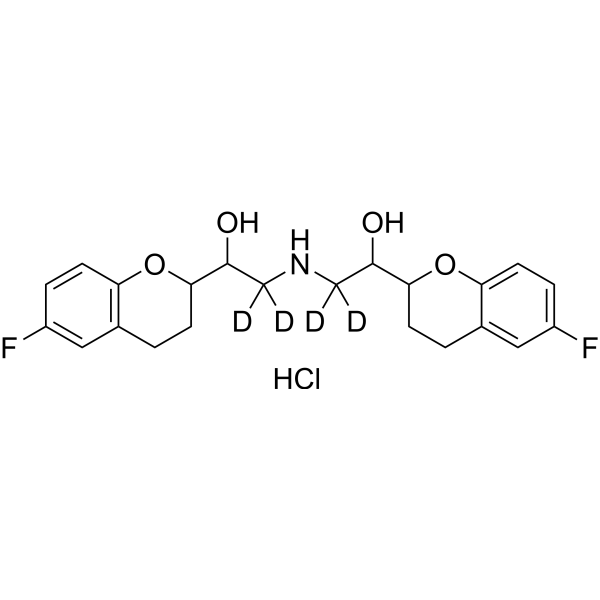 0 ImagesCat. No.: HY-W752055CAS No.: 2701283-32-9Synonyms: (Rac)-R 065824-d4 hydrochloride(Rac)-Nebivolol-d4 hydrochloride is a labelled racemic Nebivolol. Nebivolol selectively inhibits β1-adrenergic receptor with an IC50 of 0.8 nM.
-
L-770644
 0 ImagesCat. No.: HY-124208CAS No.: 173901-95-6L-770644 is an orally active, potent and selective agonist of the human β3 adrenergic receptor (EC50 = 13 nM).
-
Acepromazine-d6maleate
 0 ImagesCat. No.: HY-B1506ASCAS No.: 1331655-50-5Synonyms: Acetopromazine-d6 maleate; Acetylpromazine-d6 maleateAcepromazine-d6 (maleate) (Acetopromazine-d6 (maleate)) is deuterium labeled Acepromazine (maleate). Acepromazine (Acetopromazine) maleate is a phenothiazine tranquilizer and is alpha-adrenoceptor antagonist.
-
Luminacin C1
 0 ImagesCat. No.: HY-N14033CAS No.: 251449-89-5Luminacin C1 has a strong inhibitory effect on capillary formation (IC50 is less than 0.1 μg/mL).
-
Metoprolol Hydrochloride
 0 ImagesCat. No.: HY-17503DCAS No.: 56392-18-8Metoprolol Hydrochloride is an orally active and selective β1-adrenoceptor antagonist. Metoprolol Hydrochloride exhibits anti-inflammatory, antitumor, and anti-angiogenic properties.
-
SNAP8719 free base
 0 ImagesCat. No.: HY-123514CAS No.: 255893-38-0SNAP8719 free base is a selective α1D-adrenoceptor antagonist (pKi = 8.89). SNAP8719 free base shows affinity for the dopamine D2-, 5-HT1A-, and the human clonal α2a-adrenoceptor, with pKi values of 5.98, 6.47, and <5.0, respectively. SNAP8719 free base causes a concentration-dependent increase in the twitch response.
-
Cafaminol
 0 ImagesCat. No.: HY-105672CAS No.: 30924-31-3Cafaminol (Methylcoffanolamine) is a vasoconstrictor and anticatarrhal that selectively binds to alpha-1 receptors, causing blood vessels to constrict. Cafaminol is an xanthine derivative which can be utilized in decongestant and antitumor research.




